
Showing posts with label art. Show all posts
Showing posts with label art. Show all posts
March 09, 2009

February 24, 2009

February 04, 2009

January 11, 2009
a steady, balanced diet of
it's always sunny in philadelphia,
arrested development,
duckman,
genesis,
the killers
: : day man : : fighter of the night man : : champion of the sun : :

December 18, 2008
cui bono appétit
Been hankering to try cui (roasted guinea pig) for a while now. In mountainous Peru guinea pigs are raised for food in lieu of bulkier livestock (they reproduce quickly and require little space). The indigenous Peruvian cuisine has spread to neighboring countries, and supposedly is even served here in the States.
Imagine suburban America with a cui coop in every backyard... or better yet, guinea pens in which tri-color rodents run free until the day they become dinner. Geoff Manaugh (BLDGBLOG) recently suggested converting backyard pools for agri/aquacultural use; why not cellular edible-rodent farms?

"The Last Supper" by Marcos Zapata, 1753, hangs in the Cathedral of Cuzco (note the cui platter). I think bottom-right dude is Judas, clutching his quid pro quo below the table. He's the only person in the painting looking back at the viewer, a gaze that says: "We know something these guys don't."
Imagine suburban America with a cui coop in every backyard... or better yet, guinea pens in which tri-color rodents run free until the day they become dinner. Geoff Manaugh (BLDGBLOG) recently suggested converting backyard pools for agri/aquacultural use; why not cellular edible-rodent farms?
"The Last Supper" by Marcos Zapata, 1753, hangs in the Cathedral of Cuzco (note the cui platter). I think bottom-right dude is Judas, clutching his quid pro quo below the table. He's the only person in the painting looking back at the viewer, a gaze that says: "We know something these guys don't."
October 27, 2008

May 01, 2008

July 30, 2007
The Ecstasy of Saint Teresa
“I saw in his hands, a large golden arrow and at the end of the iron tip there appeared to be a little fire. It seemed to me this angel plunged the arrow several times into my heart and that it reached deep within me. When he drew it out, I thought he was carrying off with him the deepest part of me; and he left me all on fire with the great love of God. The pain was so great that it made me moan, and the sweetness this greatest pain caused me was so superabundant that there is no desire capable of taking it away.”

French cardinal upon seeing the sculpture: "If that is divine love, I know it well."
(Autobiography) Teresa of Avila, 1560
(Sculpture) Gian Lorenzo Bernini, 1645
French cardinal upon seeing the sculpture: "If that is divine love, I know it well."
(Autobiography) Teresa of Avila, 1560
(Sculpture) Gian Lorenzo Bernini, 1645
July 27, 2007
contra
 sharpie, ballpoint, hi-lighter, pencil
a bit suggestive for workplace doodling
perhaps
i started to write contrapposto -
classical term for human posture
in greek and rennaisance sculpture
contrast and opposition ended up
seeming more relevant
to the subject matter
click image for hi-res
July 26, 2007
The Garden of Earthly Delights
"The Garden of Earthly Delights" by Dutch artist Hieronymus Bosch (painted c. 1500) is an oil tryptich portraying the creation of the earth, its population by humans, and their subsequent descent into hell.
What a world.

Check out these sweet action figures from hell:

What a world.


Check out these sweet action figures from hell:
February 15, 2006
Hello from Calvin College,
Here are a couple of prints from my Intaglio Printmaking winter session. This was certainly an interesting course; each day for three weeks I worked in the Calvin print shop from nine o’clock in the morning to four or five in the afternoon. I learned a lot about a variety of techniques and procedures involved with this form of printmaking, and I was also able to produce a good number of different projects.
A few words on the intaglio printing process:
Intaglio printing involves scratching or carving grooves into a flat metal plate (copper in this case). These scratches can be done manually with a sharp stylus, scraper, roller, etc. They can also be achieved by etching. This process involves covering the plate with a thin coating (called ground) and scratching through that to the metal surface. Then the entire plate is placed in an acid bath which reacts to the metal and eats into the surface of the plate.
Once the surface of the plate has been prepared the real fun begins. Each plate’s edges must be beveled by file so that it will not slice through the soft paper when it is pressed. Once the edges are filed the plate is inked over the entire surface and slowly burnished clean with stiff gauze called tarlatan. If wiped properly the unscratched surface of the plate retains only a very thin layer of ink (called plate-tone) while the grooves remain filled with ink. Now the plate is ready to be pressed.
Before the paper can be pressed it must be soaked in a water bath to soften the pulp a bit and allow it to conform to the small grooves in the plate and absorb as much ink as possible. The soaked sheet of paper is blotted or dried between large sheets and a rolling pin. Then the plate is placed face up on the press bed (similar to the one pictured) and the paper is laid on top of that. A layer of dense felt separates the paper/plate from the press’s roller. Once the image has run through the press once it is ready to be pulled or separated from the plate. Now the plate is ready to be re-inked and pressed.
That’s really just the basic overall process; there are a lot of variations and intricacies involved in other aspects of intaglio printmaking. For instance, the blue water in the “Little Glen” print enclosed was achieved by mixing blue ink and a bit of mineral spirits. That solution was then painted on the plate before each pressing in only that specific area after the rest of the plate had been inked in black and wiped clean.
Each of the plates for the prints included in this package was prepared mostly by etching with acid, but they both are augmented by manual scratching (called drypoint).
I hope you all enjoy the prints, even if that means just having them on the fridge with a couple of magnets for a week or two (“Eggs & Bacon” would seem to work well in the kitchen).
January 22, 2006
Untitled (People Print)

Here's another etching, this one is in it's first state. It's basically a cartoon image, which turns out to work really well with the etching and printing process. There was no concept drawing for this print, basically I just started drawing into the ground of the blank plate and it turned into this. Since this stage of the print I've gone back and added a lot more detail - there really isn't any unused space on the plate. I like it.
You don't know...
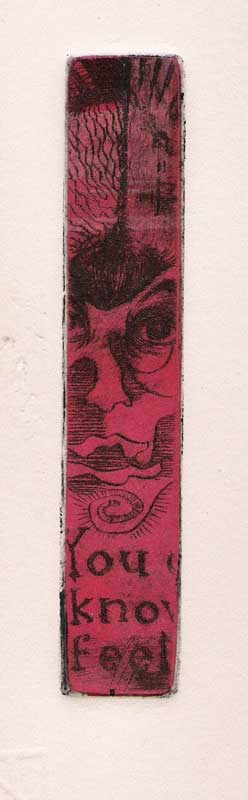 This is a very small plate done entirely in drypoint. The image comes from a drawing I did on a scrap from an earlier run of the "Subjugation of Man" print. It's basically a single contour line drawing of a face with some additionally built-up areas. In some of the down time from the etching process for other plates I was able to complete a whole edition of this print, which includes the very cool red-ink "background." This was achieved by a technique called surface rolling where the plate is inked and wiped normally, but before it is pressed another layer/color of ink is rolled onto the surface of the plate, leaving the darker ink in the grooves. I really like the way it looks.
Eggs & Bacon
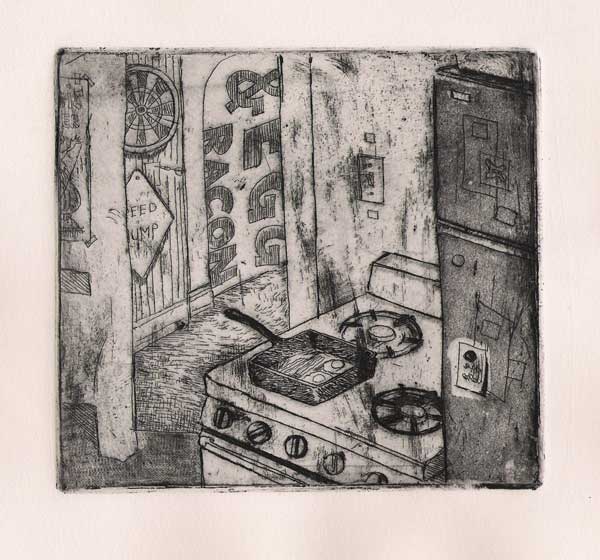
This print is for the portfolio exchange project at the end of class. The assignment was "Food," and the new cast-iron skillet had to be featured. This image consists of mostly etched lines, those in the stove and fridge are the boldest since they were left in the acid for a longer time than the background lines. The tonal area on the fridge was achieved by a process called aquatint in which a thin coat of spraypaint or resin is applied to the plate and allowed to etch (in that specific area) for a brief time. The result is a spray-paint like tone, very different from the look of built up hatch marks (such as in the carpet area). The only drypoint (manually scratched) technique on the plate was with a roulette in the floor of the kitchen. A roulette is basically a roller which leaves a uniform swath of dots where it is pressed into the plate. I chose to leave some of the incidental scratches from the etching process, I think they represent the grubbiness of the apartment and assist the image of the dartboard and street sign in adding context to the overall image.
January 16, 2006
Intaglio Printmaking Class
"The Subjugation of Man," artist's proof.
[Click on image for hi-res version]
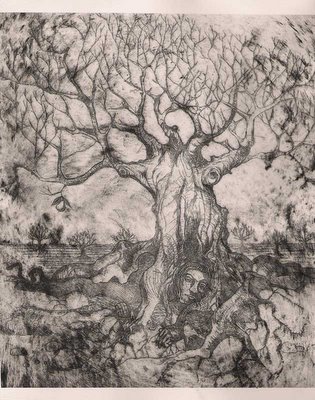
This print is an etching done with hard ground on a copper plate. Although the plate is in its final state, the print is only a proof, as evidenced by the blotches of unwiped ink in some areas. One of the most challenging aspects of intaglio printmaking is wiping the surface of the plate consistently without removing too much of the grooved ink, resulting in a weak, dim image. This task becomes even more difficult in the presence of much fine detail on the plate (clever me).
The assignment for the class was "Historical Event." I decided on a symbolic, post-fact depiction of the fall of humanity centralizing on the withered carcass of the Tree of Knowledge of Good and Evil. The human element in the image is portrayed in the form of an ancient statue which has been enshrined and nearly overtaken by the grasping root structure of the ancient tree. One of the statue's hands reaches out for the illusory fruit, perpetually out of reach. The shadow or influence of the snake is still palpable, despite the aparent expanse of time which has passed since the actual event.
"A little knowledge is a dangerous thing."
- Conventional Wisdom
[Click on image for hi-res version]
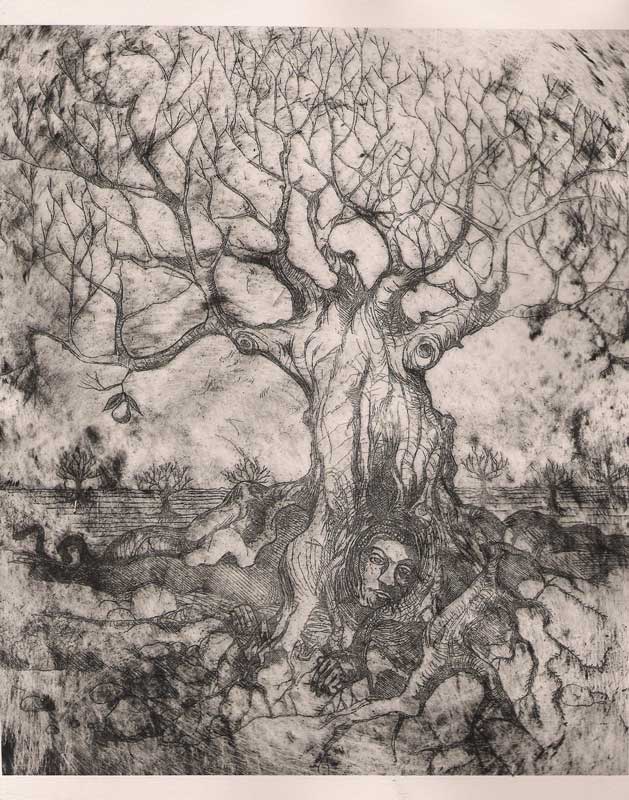
This print is an etching done with hard ground on a copper plate. Although the plate is in its final state, the print is only a proof, as evidenced by the blotches of unwiped ink in some areas. One of the most challenging aspects of intaglio printmaking is wiping the surface of the plate consistently without removing too much of the grooved ink, resulting in a weak, dim image. This task becomes even more difficult in the presence of much fine detail on the plate (clever me).
The assignment for the class was "Historical Event." I decided on a symbolic, post-fact depiction of the fall of humanity centralizing on the withered carcass of the Tree of Knowledge of Good and Evil. The human element in the image is portrayed in the form of an ancient statue which has been enshrined and nearly overtaken by the grasping root structure of the ancient tree. One of the statue's hands reaches out for the illusory fruit, perpetually out of reach. The shadow or influence of the snake is still palpable, despite the aparent expanse of time which has passed since the actual event.
"A little knowledge is a dangerous thing."
- Conventional Wisdom
Subscribe to:
Posts (Atom)