Showing posts with label philosophy. Show all posts

November 20, 2008

Kiss

Keep it simple, stupid.
Great advice;
Hurts my feelings every time.

Simply:

  1. Free your heart from hatred.
  2. Free your mind from worry.
  3. Live diligently.
  4. Expect less.
  5. Give more.

October 27, 2008

be like ben

February 20, 2008

Fear is a Renewable Resource

"America was founded by men who understood that the threat of domestic tyranny is as great as any threat from abroad. If we want to be worthy of their legacy, we must resist the rush toward ever-increasing state control of our society. Otherwise, our own government will become a greater threat to our freedoms than any foreign terrorist."

– Ron Paul, from Freedom vs. Security: A False Choice

"Always vote for principle, though you may vote alone, and you may cherish the sweetest reflection that your vote is never lost."

– John "Q-Tip" Adams

Perhaps the application of the second quote is to do the right thing even (especially) when the wall of opposition seems insurmountable. Now, where did I put my "The Good and You" reference guide? Often it is speciously simple to ossify what the right thing is. In many situations it becomes a matter of perspective. An example is the spectrum of viewpoints on current military action by the United States.

I have encountered, and at times been a self-contained example of, an array of conflicting beliefs held by the highest conviction as being right. I find it epistemologically problematic when people hold contradictory, irreconcilable absolutes. If, as Lennon/McCartney placed in addled words, "I am he as you are he as you are me and we are all together," then I feel a shared culpability for others' absolutes, as they could easily have been my own. This affliction of empathy is uncommon amongst the highly polarized/politicized compartments of Democrats and Republicans. The team-mentality of election time in the U.S. is a playful outcropping of a deep need for "Us and Them," a deadly way of alleviating our personal fear and guilt by clinging to a group dependent on each other for survival.

I think we are each imbued with an innate sense or intuition for the good, although that intuition requires empirical honing. That honing should include drawing on the collective experience of history to augment our individual lens for the world. My personal intuition about implementing the good has been very haze-y in recent years, but some developments have emerged. "Revolution is dead." "Why bother?" "There is nothing new under the sun." Lazy pessimism. The battle of wills that has raged for the millennia is a race toward death, but there is, perhaps, another way. It involves withdrawal and self-sacrifice, not revivalist coercion or militant fascism. Thomas Jefferson wrote:

"To preserve the freedom of the human mind and freedom of the press, every spirit should be ready to devote itself to martyrdom; for as long as we may think as we will, and speak as we think, the condition of man will proceed in improvement."

It's all about Freeeedom, man. Liberty. Not the vacuous hedonism of self-destruction and dogmatic nihilism. Nor the false construct of mystical superstition. I appreciate the inclusion of "freedom of the press" as a sibling to "freedom of the human mind." The communication of ideas, education by a variety of perspectives, is the best hope for the improvement of the condition of man.

I was looking for a clip from King of the Hill where Dale Gribble (a cartoon hero of mine) is using bookstore basement as a firing range.

"And so we say farewell to A Farewell to Arms."
[Blasts a giant hole through the dangling book.]

Copyright-infringement-free YouTube has failed me, but I did come across this, which seemed relevant (and priggishly obscure) enough:


The Minute Men perform "King of the Hill" – I checked out some more of their stuff. Don't really care for the sound, a kind of frantic, strained, ska-punk-pop. And thought the production value of this video was pretty childish (ok, I like the part where the big dude rolls down the hill). But their counterculture appeal against modern feudalism is cool.

November 08, 2007

superPOST (#100)

What exists?

on·to·logy - noun

the study of conceptions of reality and the nature of being.

on·to·log·i·cal - adjective

  1. Of or relating to ontology.
  2. Of or relating to essence or the nature of being.
  3. Of or relating to the argument for the existence of God holding that the existence of the concept of God entails the existence of God.

In the 11th century Anselm argued the existence of God a priori (from what comes before). Without a lot of philosophy jargon: God exists because the concept of God exists (see definition #3 above). A similar ontological foundation was put forth by Descartes hundreds of years later: "I think, therefore I am."

Two holes:
a. this argument limits the being of God to a human cognitive scale
b. the concept of a unicorn also exists

What exists?
Tacos, enchiladas, chile rellenos, and Grey Goose Le'Citron


A fine meal served at La Tolteca Express, particularly notable since I was the only patron in the entire restaurant.

"Hell is other people."
- Sartre

. .. ... .. . .. ... .. . .. And For Good Measure ... .. . .. ... .. . .. ... .. .

"Two of the greatest poker minds." Bear in mind that they're playing with their own CASH. That's what makes GSN's "High Stakes Poker" the best on television. Also Gabe Kaplan's masterful commentary.


If you really want to feel sick (or schadenfreude), check out this hand between Gus Hansen and Daniel Negreanu.

October 23, 2007

Who are you?

Where does the world come from?

June 10, 2007

sol·ip·sism - noun

  1. Philosophy. The theory that only the self exists, or can be proved to exist
  2. Extreme preoccupation with and indulgence of one's feelings, desires; egoistic self-absorption

May 01, 2006

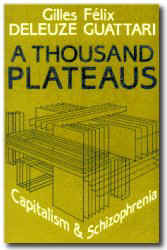
Rhizomorphic: Thousand Plateaus

"There's no 'rationalist methodology' in A THOUSAND PLATEAUS. Just an orgy of concepts. Concepts aren't part of logical train of thought in Deleuze and Guattari; they're more like riffs in a guitar piece. Make that a cut of a wild electronica remix!"

No, Deleuze and Guattari are not members of the band...not exactly. Here's a list of their contributions (to the band and the world) sans rationalist methodology:

idiosynchratic vocabulary pre-conventional world of the unconscious disjointed random multiplicitous Dali-Freud-Kantian parody quasiphilosophy disjointed impenetrable postmodern sentiments

Ok, any questions? All right, let's back it up - beeeep beeeep beeeeep! Over the course of human history (that's right, we're backing it all the way up) the study of philosophy has been an outlet for whiney self-involved weirdos to bitch and moan about the meaning of life, thusly excusing them from manual labor. However, following some hundreds of years of investigation and incremental amassing of knowledge and understanding something happened. We reached a point as humans where we had finally accumulated so much learning that we could draw one conclusion: we ain't got a clue. This is referred to by Charles Young as the crisis of meaning - a psychologically violent moment of thrashing the drawing board clear, leaving behind depths of nothingness. This is kind of a spooky place for the philosophy train to deliver us ("End of the line!") Was it worth it? Have the thousands of years of philosophical tail-chasing all been for naught?


Clearly not, good friends! If nothing else, the progress (or digress) of philosophy has rendered at least one brilliant nugget of shiny goodness - "A Thousand Plateaus." This time I am referring to the band, not the text (referenced at top) from which the band has gleaned its name. Yes, like the text their lyrics are densely idiosychratic and more than a little referrential.

I recently had the opportunity to discuss this issue with a member of the band, Doug (keyboards, pictured). I mentioned to him that I had done a little investigating into the source of the band's new name, discovering that the philosophy text of the same title was regarded with some controversy. To my amusement, most of the reviews of the book were derogatory and undermining, stating it to be, effectively, Mumbo Jumbo. Poppycock. Balderdash. Doug told me that such a reaction made sense coming from 'outsiders' to (as I recall) continental philosophy.

Idiosynchratic vocabulary (read: made-up words, grammar, etc.) and obscured blurry concepts are indeed potential turn-offs for outsiders to philosophy, but what about music? Do approachable lyrics detract from the comment that "A Thousand Plateaus" is trying to make? If so, what exactly is that comment?

Non-sensical jackassery is certainly not it.

February 16, 2006

You Say You Want a Revolution...

"All fixed, fast-frozen relations, with their train of ancient and venerable prejudices and opinions, are swept away, all new-formed ones become anitquated before they can ossify. All that is solid melts into air, all that is holy is profaned, and man is at last compelled to face with sober senses, his real conditions of life, and his relations with his kind."
- Marx/Engels


AT LAST COMPELLED TO FACE WITH SOBER SENSES HIS REAL CONDITION IN LIFE...

...but what does that have to do with communism? It is my understanding that Marx was compelled to investigate what he perceived to be a broken socio-economic system (yep, capitalism). He determined that this establishment perpetuated a false consciousness, one which he was able to transcend thus endowing him with special insight into the condition of man.

To claim that such an awakening can occur in unadulterated isolation from one's own potentially flawed personal motivations and biases may be unduly founded. There seems to exist a limit or selection of introspection which contributes (or initiates) so many accounts of philosophical pontificating. Marx's ideas, not unlike any other, built on existing modes of philosophical thought and applied them to a case-specific social/economic world, the one in which he lived. It is clear to say now, if not then, that certain dimensions of Marx's ideology could be considered obsolete or ill-functional in the contemporary socioeconomic climate - for instance, violent revolution.
This is not to say that the thoughts, as a whole, of Marx or any other of his peers in the field of thought, are to be categorically discarded. Yet, the independent functionalism of each case should be examined, placed into contextual perspective, and handled accordingly.

That being said, the life of a radical Marxist revolutionary does have a certain appeal...