January 22, 2006

Untitled (People Print)


Here's another etching, this one is in it's first state. It's basically a cartoon image, which turns out to work really well with the etching and printing process. There was no concept drawing for this print, basically I just started drawing into the ground of the blank plate and it turned into this. Since this stage of the print I've gone back and added a lot more detail - there really isn't any unused space on the plate. I like it.

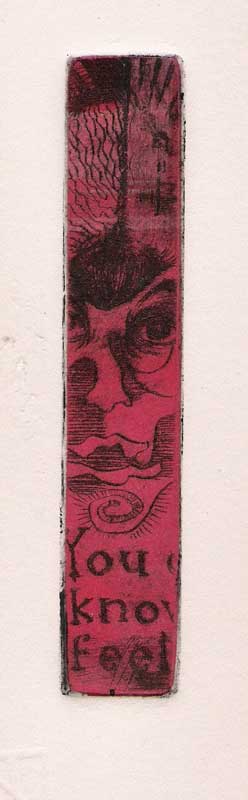
You don't know...

This is a very small plate done entirely in drypoint. The image comes from a drawing I did on a scrap from an earlier run of the "Subjugation of Man" print. It's basically a single contour line drawing of a face with some additionally built-up areas. In some of the down time from the etching process for other plates I was able to complete a whole edition of this print, which includes the very cool red-ink "background." This was achieved by a technique called surface rolling where the plate is inked and wiped normally, but before it is pressed another layer/color of ink is rolled onto the surface of the plate, leaving the darker ink in the grooves. I really like the way it looks.

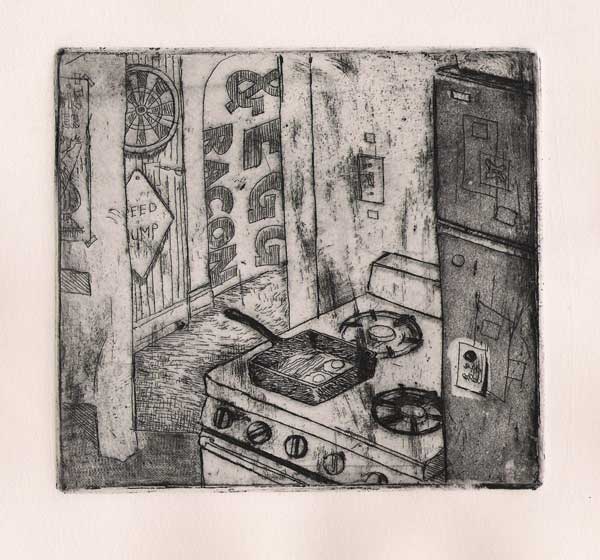
Eggs & Bacon


This print is for the portfolio exchange project at the end of class. The assignment was "Food," and the new cast-iron skillet had to be featured. This image consists of mostly etched lines, those in the stove and fridge are the boldest since they were left in the acid for a longer time than the background lines. The tonal area on the fridge was achieved by a process called aquatint in which a thin coat of spraypaint or resin is applied to the plate and allowed to etch (in that specific area) for a brief time. The result is a spray-paint like tone, very different from the look of built up hatch marks (such as in the carpet area). The only drypoint (manually scratched) technique on the plate was with a roulette in the floor of the kitchen. A roulette is basically a roller which leaves a uniform swath of dots where it is pressed into the plate. I chose to leave some of the incidental scratches from the etching process, I think they represent the grubbiness of the apartment and assist the image of the dartboard and street sign in adding context to the overall image.

January 17, 2006

Dream Deferred

I had to memorize a poem last semester for the final exam of a literature class. I chose Langston Hughes' "Dream Deferred," partially because I enjoy his work, but mostly because it was sparse in words and barely edged the required ten-line minimum:


What happens to a dream deferred?

Does it dry up
like a raisin in the sun?
Or fester like a sore --
And then run?
Does it stink like rotten meat?
Or crust and sugar over --
like a syrupy sweet?

Maybe it just sags
like a heavy load.

Or does it explode?


This one officially gets my "Good Poem" stamp of approval, comparable to the Pulitzer I would imagine. My question, though, is what happens when there is no dream at all?

January 16, 2006

Intaglio Printmaking Class

"The Subjugation of Man," artist's proof.

[Click on image for hi-res version]


This print is an etching done with hard ground on a copper plate. Although the plate is in its final state, the print is only a proof, as evidenced by the blotches of unwiped ink in some areas. One of the most challenging aspects of intaglio printmaking is wiping the surface of the plate consistently without removing too much of the grooved ink, resulting in a weak, dim image. This task becomes even more difficult in the presence of much fine detail on the plate (clever me).

The assignment for the class was "Historical Event." I decided on a symbolic, post-fact depiction of the fall of humanity centralizing on the withered carcass of the Tree of Knowledge of Good and Evil. The human element in the image is portrayed in the form of an ancient statue which has been enshrined and nearly overtaken by the grasping root structure of the ancient tree. One of the statue's hands reaches out for the illusory fruit, perpetually out of reach. The shadow or influence of the snake is still palpable, despite the aparent expanse of time which has passed since the actual event.

"A little knowledge is a dangerous thing."
- Conventional Wisdom

December 06, 2005

Mindfulness Part 3: Situational Analysis and Politics

I think that if I were asked to sum up the idea of mindfulness in a single phrase it would be situational analysis. To reiterate somewhat, entrapment occurs when pre-set categories, notions, mindsets, predjudices (call it what you will) override an individual's point-of-view. There are so many valid and important aspects of daily activities and life in general to which the concept of situational analysis applies.

One recent topic of discussion was a broad wash regarding politics - perfect! Last fall there was a full-size billboard adjacent to a somewhat rundown section of Wealthy Street. It loudly proclaimed in verse: "DON'T TAKE NO STATIC, VOTE STRAIGHT DEMOCRATIC!" As it was on my daily bus route, I was presented with many opportunities to view and ponder this sign. There are probably three or four potential "issues" about this sign, the least of which is not the phrasology of the message, but for the sake of simplicity (and my own peace of mind) I'll try and stick with just the straight ballot aspect.

The situation at hand is the decision for which (if any) of multiple candidates in multiple races to vote for. To select a straight ballot option with only consideration for the 50/50 (Dems/GOP) is to disregard virtually all functional analysis. In fact, I personally regard the very notion of blindly rattling off R, R, R, R...down the list of options to be quite distasteful. I think that simply knowing which party a candidate is aligned with is not nearly enough information on which to base the casting a vote. Yet, I would imagine (this is pure conjecture) that 75-90% of the voting that takes occurs is based primarily on "us and them" and not much more. A better consideration for how to vote may be to analyze qualities and issues offered by political candidates and base voting on a cognitive result, not a pre-set category. For that matter, I think it's better to not vote at all than to vote arbitrarily.

Speaking of political categories, it bugs me when people ask if someone is a Republican or a Democrat. We've managed to polarize and reduce American politics to red and blue - each individual is immensely pressured by the culture to compartmentalize themselves as a "member" of one party or another. Is it so wholly unimaginable that someone may be fiscally liberal and socially conservative? Maybe someone strongly supports environmenal preservation and simultaneously opposes to legalized abortion? Each issue (situation) requires contextual analysis. Sure, one may analyze and decide to subscribe to the vast majority of a particular party's stances on issues, but to insist on labeling "our side" is PROBLEMATIC.

"When ignorance is bliss, 'tis folly to be wise." - Thomas Gray

November 01, 2005

The Master's Lament

Q. "Why must I lose to this idiot!?"

Chess Master Aaron Nimzowitzch
after having leapt onto a table during
a tournament.

A. Because you can.

October 31, 2005

Mindfulness Part 2: Education for Outcome

"From kindergarten on, the focus of schooling is usually on future goals, rather than on the process by which they are achieved. The single minded pursuit of one outcome or another (i.e. - getting into Harvard) makes it difficult to have a mindful attitude about life (Langer 33)."

This idea is closely related to the concept behind my frustrations from an earlier post, The Art of the Resume. Langer has identified what I believe to be a major flaw in our current culture's approach to education, and other aspects of our culture as well.

Yoda: "Always on the future his mind is, never on the here and now."

As Langer points out, from very early on the main end of schooling was to advance to something else - the next grade, good college, good job, etc. Case in point: high school "SAT" courses which focus solely on improving student's test-taking skills. What a sickening concept, teaching kids how to amplify their results based on what are essentially tips and tricks. Back in the good ol' days they used to have classes which improved SAT scores, too. They were called math and english and history.

The main point is this; such a heavy focus on the ends causes a disregard for the means. In this case, the means is education - the gaining of knowledge about the world, about one's self, and about God. "Pish-posh," says our culture, education is merely a conveyance. In other cultures the journey is as or more important than the destination. I believe, as I imagine Langer does as well, that our culture has fallen out of sync with a healthy balance between the two. I feel that a better understanding and approach to engaging students in the process of education would, ironically, be a dramatic benefit to the same goal that the current tradition holds.

There are other negative aspects to outcome based education as well. When children take up a new activity with an outcome-based orientation there exists a "predominate anxious preoccupation with failure." The emphasis is on "Can I or can't I?" as opposed to "How do I?" A result of this mindset is an inordinately mindless fear of failure. I can't tell you how many times I've witnessed the utter trauma that simple math test has caused in so many of my peers' lives. I mean I have seen individuals near the point of mental breakdown over an insufficient grade on one test (or more commonly over the fear of a pending grade being insufficient). One such example occured very recently following a Cultural Anthropology midterm. About a week after the test before a Friday class I over heard a girl say that if she didn't get her test results back that day it would ruin her whole weekend. I sincerely hoped for her sake that she was being facetious, but I suspect that there was some truth in her comment. Can you see how unhealthy such a preeminant focus on failure is? This girl almost certainly could not care less whether she actually learned about other cultures, all she was concerned with was the grade. In my own academic career there have been many times where my sole motivation for performing a task was the sheer terror of getting a bad grade.

I was reminded by this section of the text of an interview I read. The actor Owen Wilson was being interviewed by a magazine and one question/answer stood out to me even before I read the Langer text:

MAGAZINE: Have you gotten better at dealing with criticism?
WILSON: Now if a movie goes south it might not capsize me like it used to. But I still have a terrible fear of failure. My father gave me a [Samuel] Beckett quote, "Try again. Fail again. Fail better." I find that really liberating.

I believe that outcome based education is a disfunctional tradition. A healthier system would include more emphasis and value placed on learning and education as more than just a vehicle. The key words of Beckett's quote are fail better. There are no failures, only ineffective solutions. The only real failures occur when one becomes so hung up on a "failure" that they fail to use the experience as an opportunity for betterment. So the "Culture of Failure" is not a failure, but simply an ineffective solution for achieving said outcomes. The key is thoughtful consideration of what is going on and how to deal with it.

October 21, 2005

Poker Sucks

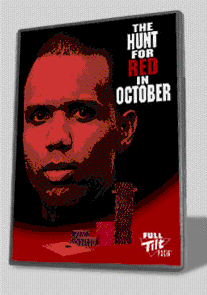
Ok, poker is a big joke these days but I just had to post this pic from the FullTilt homepage. I don't know exactly what it was a promo for, but I found the image to be hilarious. There's something about seeing Phil Ivey's shadowy face in a reference to where Sean Connery would normally appear that I find totally ridiculous. Phil Ivey is such a champ.


The handles of the pros on this site appear in red, which I believe is the root of the pun "The Hunt for RED in October" as opposed to the Tom Clancy movie The Hunt for Red October.

October 20, 2005

Poetry Post

Author's Note: Here's another post that I made on the discussion board for my literature class. Our study has shifted from literary fiction (primarily short stories) to poetry. As one may imagine, the study of poetry has created somewhat of a discontented stir amongst the students. Now, when there's discontent going on I'm usually inclined to be in on it. The following is a response to a post by my fellow student Aaron V. in which he discussed his frustrations with poetry in general:

I appreciate that Aaron has articulated his idea about poetry being an esoteric club, one which requires specific training in order to enter. It is apparent to me that once one is trained to understand poetry they often feel compelled to enforce upon themselves an appreciation for it. This is most pointedly true for me in my own experience. For instance, today I was flipping through the most recent issue of the Dialogue publication at Calvin. Indeed, I was actually reading the poems and feeling their effect (well, some of them at least). Upon realizing that I was getting into it, I started to feel guilty about a previous interaction with the Dialogue. That previous experience was as follows:

One evening when I was a freshman living in RVD I was hanging out with some friends of mine at the smoke pit*. We discovered a copy of the Dialogue that someone had left behind and it spurred a conversation about the usefulness of such a publication. Now I of all people should have at least been able to play devil's advocate and stick up for a publication of the arts (as I have frequented the Spoelhof basement for many classes here at Calvin). Instead, I found that I much preferred to bash it as a bunch of lofty b.s. produced by people who were either trying to fool the reader into thinking they were deep, or had already fooled themselves. Well, the combination of the presence of lighters and a large, sand-filled ash basin was too much to resist and the pages of the Dialogue were soon being consumed by flames of protest.

Or we were just being jackasses via an insensitive display of, as Aaron would put it, ignorant frustration. As I said, the memory of that incident caused me to feel some guilt today, but that feeling of guilt was soon replaced by another thought...a question. Have I fooled myself? The various ways I have interacted with the Dialogue represent two distinct mindsets (a.k.a. perspective or point-of-view). My current perspective is more open-minded to poetry, but does that prevent my previous mindset from being equally valid? Now instead of feeling guilty I was a bit unsure, scared that I might be one of those people who is compelled to be "into" something just because they know how to; like Aaron said, a part of something bigger than themselves. It is certainly comforting to be able to reassure one's cognitive capacities by exercising skill in reading/understanding poetry. I fear that the effect or meaning - possibly subconsciously self-enforced - that some of the poems have may be an outlet of that reassurance.
This, I believe, points to the fact that our respective realities are a construct of whatever mindset we happen to be in at that point in time. Here's a somewhat hypothetical generalization: I once found poetry to be frustrating and useless, now I find it to be interesting and meaningful. Now, when I am confronted with someone who finds poetry to be frustrating and useless I think that they are wrong. But they are me. Their ideas are valid, and I must respect that (in the same way that I didn't respect the ideas of the other side when I participated in the Dialogue burning). My point is this (and I would imagine that Aaron may agree); I call into question the tradition of enforcing poetry on students as being a good thing. In my experience, many poems are primarily successful only in polarizing the reading audience. Some people don't get it and immediately tune it out, while others revel in their ability to get it and perpetuate what makes them feel better than the people who don't by writing more poetry.

Granted, this is an extremely cynical conceptualization about poetry in education, and you probably shouldn't buy into what I'm saying. Honestly, however, it is the way (or at least a way) that I am inclined to think. Maybe a year from now my mindset will have changed again and I can have an argument with my former self and prove that jerk wrong once and for all.

*Ok, I better qualify this a little bit for fear of misinterpretation. Many of my friends at Calvin are smokers, or at least smoke occasionally. In dealing with that, I have found that some of the most genuine social interaction in all of my experiences at Calvin has occurred while hanging out at the smoke pits. Unfortunately a resultant of this was the breaking of a promise that I once made as a very young kid to my parents (I remember speaking the actual words), "I will never smoke even a single cigarette." Ah, I'm beginning to understand the relevance of the cliché "never say never." Yes, I have sampled a cigarette or two, but I am under no delusions about the negative health implications of smoking, not to mention its potential for addiction, so I've tried to keep it under the auspices of responsible freedom. So please, please, please don't call me in a giant frenzy about how evil smoking is because I already know that you are right.