March 16, 2006

My Only Friend, The End


College graduation is approaching, and yet it feels more like doomsday. At the end of a long session in the education game the time has come to cash out the chips, but it's hard to tell if I'm winning or losing. I sense that my shortcomings in academic performance may soon be coming to bear in a very real way, perhaps for the first time. Instead of anticipating the future with a sense of eagerness I feel racked by aprehension, guilt, fear, regret - frozen by the constant psychological torment of self-examination.

I am constantly confronted with the idea of "accomplishment," and I fear that I will never accomplish anything of true validity (graduating from college DOES NOT COUNT). This stems from a realization that my own portfolio of previous accomplishments, once held in high regard by myself, amount to very very little. My understanding of the most basic and unilateral human accomplishment is one of procreation - perpetuating the species. Even (especially?) that task seems to hold little prospect.
In effect, the model for life presented by the Verve in "Bittersweet Symphony" has occupied my thoughts. The line goes, "You try to make ends meet / You're a slave to money, then you die." At Calvin we are taught the ideology of vocation - serving God's kingdom in our occupation. I'm all about it in theory...on a basic philosophical level this way of thinking is both applicable and beneficial to humanity. However, as well exhibited in my own life, the gap between saying and doing is often of unreachable span. I do believe that I have unique talents and am capable of rendering useful, productive, essential contribution to the world. I now understand that the world is not going to come knocking, requesting and pleading for that contribution. If I want to fulfill a life of accomplishment I must go forth and enact my own path - pushing rather than being pushed. Needless to say, my pushing muscles need some serious toning.

P.S. - No more than 10 minutes after first publishing this post I was reading in the coffee shop when "Bittersweet Symphony" played. I am finding such coinciedences to be occurring in increased concentration, and I have begun to think of such incidences more as synchronicity than coincidence. Everything under the sun is in tune?

February 16, 2006

Hooray for Little Feat!


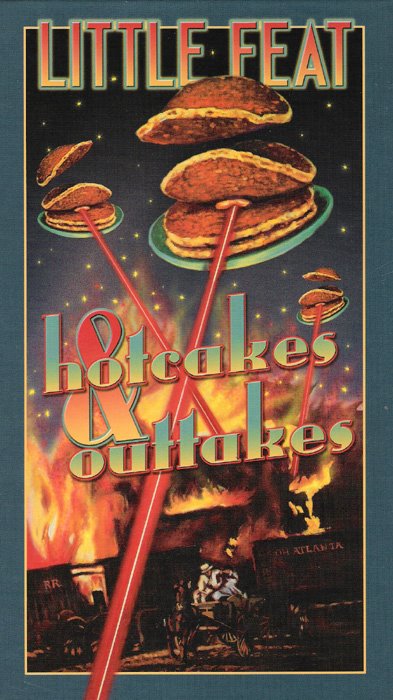
Since the name of the blog reflects my obscure preference for the band Little Feat it seems apropriate to mention that I have been listening to way way way too much as of recent. My two new favorites are "Mercenary Territory" and "Spanish Moon," which incidentally seem to find themselves in close company on all three Little Feat Albums with varying versions (er, two) of those two songs. Five versions of "All That You Dream" and counting....

You Say You Want a Revolution...

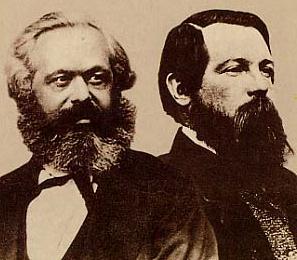
"All fixed, fast-frozen relations, with their train of ancient and venerable prejudices and opinions, are swept away, all new-formed ones become anitquated before they can ossify. All that is solid melts into air, all that is holy is profaned, and man is at last compelled to face with sober senses, his real conditions of life, and his relations with his kind."
- Marx/Engels


AT LAST COMPELLED TO FACE WITH SOBER SENSES HIS REAL CONDITION IN LIFE...

...but what does that have to do with communism? It is my understanding that Marx was compelled to investigate what he perceived to be a broken socio-economic system (yep, capitalism). He determined that this establishment perpetuated a false consciousness, one which he was able to transcend thus endowing him with special insight into the condition of man.

To claim that such an awakening can occur in unadulterated isolation from one's own potentially flawed personal motivations and biases may be unduly founded. There seems to exist a limit or selection of introspection which contributes (or initiates) so many accounts of philosophical pontificating. Marx's ideas, not unlike any other, built on existing modes of philosophical thought and applied them to a case-specific social/economic world, the one in which he lived. It is clear to say now, if not then, that certain dimensions of Marx's ideology could be considered obsolete or ill-functional in the contemporary socioeconomic climate - for instance, violent revolution.
This is not to say that the thoughts, as a whole, of Marx or any other of his peers in the field of thought, are to be categorically discarded. Yet, the independent functionalism of each case should be examined, placed into contextual perspective, and handled accordingly.

That being said, the life of a radical Marxist revolutionary does have a certain appeal...

February 15, 2006

Hello from Calvin College,

Here are a couple of prints from my Intaglio Printmaking winter session. This was certainly an interesting course; each day for three weeks I worked in the Calvin print shop from nine o’clock in the morning to four or five in the afternoon. I learned a lot about a variety of techniques and procedures involved with this form of printmaking, and I was also able to produce a good number of different projects.

A few words on the intaglio printing process:

Intaglio printing involves scratching or carving grooves into a flat metal plate (copper in this case). These scratches can be done manually with a sharp stylus, scraper, roller, etc. They can also be achieved by etching. This process involves covering the plate with a thin coating (called ground) and scratching through that to the metal surface. Then the entire plate is placed in an acid bath which reacts to the metal and eats into the surface of the plate.

Once the surface of the plate has been prepared the real fun begins. Each plate’s edges must be beveled by file so that it will not slice through the soft paper when it is pressed. Once the edges are filed the plate is inked over the entire surface and slowly burnished clean with stiff gauze called tarlatan. If wiped properly the unscratched surface of the plate retains only a very thin layer of ink (called plate-tone) while the grooves remain filled with ink. Now the plate is ready to be pressed.

Before the paper can be pressed it must be soaked in a water bath to soften the pulp a bit and allow it to conform to the small grooves in the plate and absorb as much ink as possible. The soaked sheet of paper is blotted or dried between large sheets and a rolling pin. Then the plate is placed face up on the press bed (similar to the one pictured) and the paper is laid on top of that. A layer of dense felt separates the paper/plate from the press’s roller. Once the image has run through the press once it is ready to be pulled or separated from the plate. Now the plate is ready to be re-inked and pressed.

That’s really just the basic overall process; there are a lot of variations and intricacies involved in other aspects of intaglio printmaking. For instance, the blue water in the “Little Glen” print enclosed was achieved by mixing blue ink and a bit of mineral spirits. That solution was then painted on the plate before each pressing in only that specific area after the rest of the plate had been inked in black and wiped clean.

Each of the plates for the prints included in this package was prepared mostly by etching with acid, but they both are augmented by manual scratching (called drypoint).

I hope you all enjoy the prints, even if that means just having them on the fridge with a couple of magnets for a week or two (“Eggs & Bacon” would seem to work well in the kitchen).

January 22, 2006

Untitled (People Print)


Here's another etching, this one is in it's first state. It's basically a cartoon image, which turns out to work really well with the etching and printing process. There was no concept drawing for this print, basically I just started drawing into the ground of the blank plate and it turned into this. Since this stage of the print I've gone back and added a lot more detail - there really isn't any unused space on the plate. I like it.

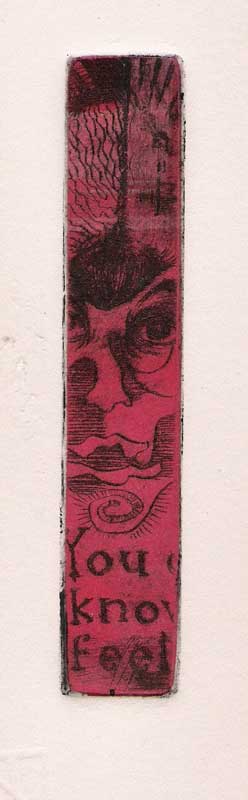
You don't know...

This is a very small plate done entirely in drypoint. The image comes from a drawing I did on a scrap from an earlier run of the "Subjugation of Man" print. It's basically a single contour line drawing of a face with some additionally built-up areas. In some of the down time from the etching process for other plates I was able to complete a whole edition of this print, which includes the very cool red-ink "background." This was achieved by a technique called surface rolling where the plate is inked and wiped normally, but before it is pressed another layer/color of ink is rolled onto the surface of the plate, leaving the darker ink in the grooves. I really like the way it looks.

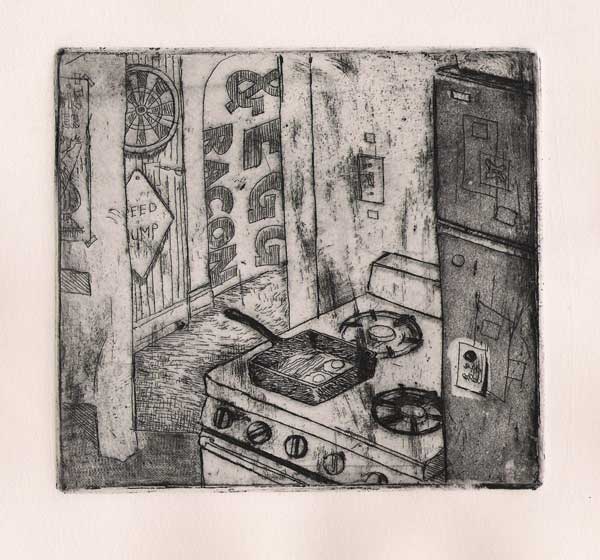
Eggs & Bacon


This print is for the portfolio exchange project at the end of class. The assignment was "Food," and the new cast-iron skillet had to be featured. This image consists of mostly etched lines, those in the stove and fridge are the boldest since they were left in the acid for a longer time than the background lines. The tonal area on the fridge was achieved by a process called aquatint in which a thin coat of spraypaint or resin is applied to the plate and allowed to etch (in that specific area) for a brief time. The result is a spray-paint like tone, very different from the look of built up hatch marks (such as in the carpet area). The only drypoint (manually scratched) technique on the plate was with a roulette in the floor of the kitchen. A roulette is basically a roller which leaves a uniform swath of dots where it is pressed into the plate. I chose to leave some of the incidental scratches from the etching process, I think they represent the grubbiness of the apartment and assist the image of the dartboard and street sign in adding context to the overall image.

January 17, 2006

Dream Deferred

I had to memorize a poem last semester for the final exam of a literature class. I chose Langston Hughes' "Dream Deferred," partially because I enjoy his work, but mostly because it was sparse in words and barely edged the required ten-line minimum:


What happens to a dream deferred?

Does it dry up
like a raisin in the sun?
Or fester like a sore --
And then run?
Does it stink like rotten meat?
Or crust and sugar over --
like a syrupy sweet?

Maybe it just sags
like a heavy load.

Or does it explode?


This one officially gets my "Good Poem" stamp of approval, comparable to the Pulitzer I would imagine. My question, though, is what happens when there is no dream at all?

January 16, 2006

Intaglio Printmaking Class

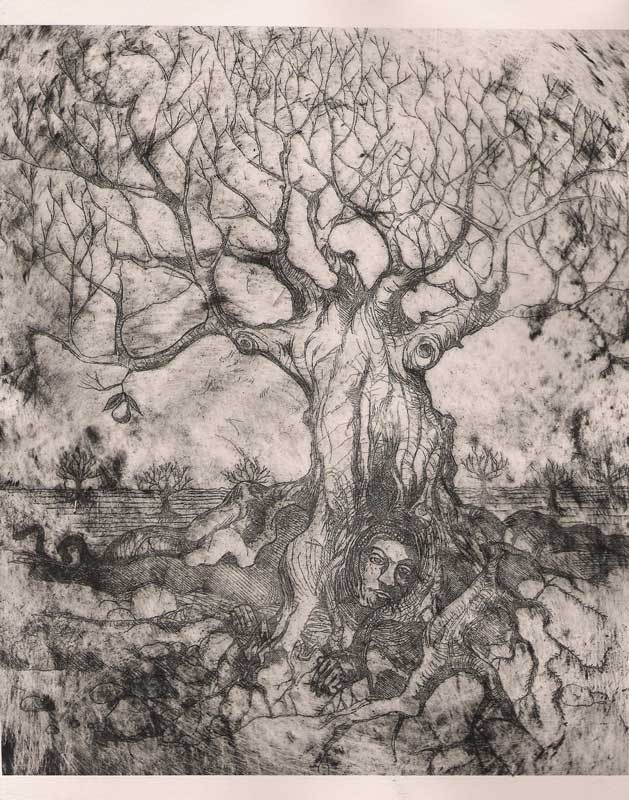
"The Subjugation of Man," artist's proof.

[Click on image for hi-res version]


This print is an etching done with hard ground on a copper plate. Although the plate is in its final state, the print is only a proof, as evidenced by the blotches of unwiped ink in some areas. One of the most challenging aspects of intaglio printmaking is wiping the surface of the plate consistently without removing too much of the grooved ink, resulting in a weak, dim image. This task becomes even more difficult in the presence of much fine detail on the plate (clever me).

The assignment for the class was "Historical Event." I decided on a symbolic, post-fact depiction of the fall of humanity centralizing on the withered carcass of the Tree of Knowledge of Good and Evil. The human element in the image is portrayed in the form of an ancient statue which has been enshrined and nearly overtaken by the grasping root structure of the ancient tree. One of the statue's hands reaches out for the illusory fruit, perpetually out of reach. The shadow or influence of the snake is still palpable, despite the aparent expanse of time which has passed since the actual event.

"A little knowledge is a dangerous thing."
- Conventional Wisdom

December 06, 2005

Mindfulness Part 3: Situational Analysis and Politics

I think that if I were asked to sum up the idea of mindfulness in a single phrase it would be situational analysis. To reiterate somewhat, entrapment occurs when pre-set categories, notions, mindsets, predjudices (call it what you will) override an individual's point-of-view. There are so many valid and important aspects of daily activities and life in general to which the concept of situational analysis applies.

One recent topic of discussion was a broad wash regarding politics - perfect! Last fall there was a full-size billboard adjacent to a somewhat rundown section of Wealthy Street. It loudly proclaimed in verse: "DON'T TAKE NO STATIC, VOTE STRAIGHT DEMOCRATIC!" As it was on my daily bus route, I was presented with many opportunities to view and ponder this sign. There are probably three or four potential "issues" about this sign, the least of which is not the phrasology of the message, but for the sake of simplicity (and my own peace of mind) I'll try and stick with just the straight ballot aspect.

The situation at hand is the decision for which (if any) of multiple candidates in multiple races to vote for. To select a straight ballot option with only consideration for the 50/50 (Dems/GOP) is to disregard virtually all functional analysis. In fact, I personally regard the very notion of blindly rattling off R, R, R, R...down the list of options to be quite distasteful. I think that simply knowing which party a candidate is aligned with is not nearly enough information on which to base the casting a vote. Yet, I would imagine (this is pure conjecture) that 75-90% of the voting that takes occurs is based primarily on "us and them" and not much more. A better consideration for how to vote may be to analyze qualities and issues offered by political candidates and base voting on a cognitive result, not a pre-set category. For that matter, I think it's better to not vote at all than to vote arbitrarily.

Speaking of political categories, it bugs me when people ask if someone is a Republican or a Democrat. We've managed to polarize and reduce American politics to red and blue - each individual is immensely pressured by the culture to compartmentalize themselves as a "member" of one party or another. Is it so wholly unimaginable that someone may be fiscally liberal and socially conservative? Maybe someone strongly supports environmenal preservation and simultaneously opposes to legalized abortion? Each issue (situation) requires contextual analysis. Sure, one may analyze and decide to subscribe to the vast majority of a particular party's stances on issues, but to insist on labeling "our side" is PROBLEMATIC.

"When ignorance is bliss, 'tis folly to be wise." - Thomas Gray